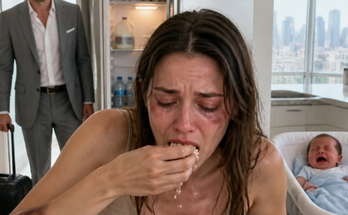
The Flowers on the Ice
He had picked the flowers himself. That matters, for some reason — that he hadn’t sent someone, hadn’t ordered them delivered, but had stood in the cold outside the flower stall on the corner of Fourth and Main at 7:00 AM and chosen them one by one. Yellow roses, because Lucía had said once that white ones looked like apologies. He had a baby blanket under his arm, soft gray, monogrammed with an L he’d had embroidered weeks ago, impatient and certain and full of the particular joy that belongs to people who don’t yet know what is about to happen to them.
He was smiling when the automatic doors came into view.
He was smiling when he saw her.
Then he stopped.
— — —
She was on the ground. Not collapsed — seated, deliberately, back against the concrete pillar beside the entrance, as though she had chosen this spot and intended to stay in it. Hospital gown. Bare feet on the frozen pavement, the skin of them gone the color of old wax. A newborn pressed to her chest — wrapped in nothing but the thin cotton of her gown, bundled against her with both arms, her body curved around it like a question mark, like a shell.
Her lips were purple. Her eyes were open. Dry.
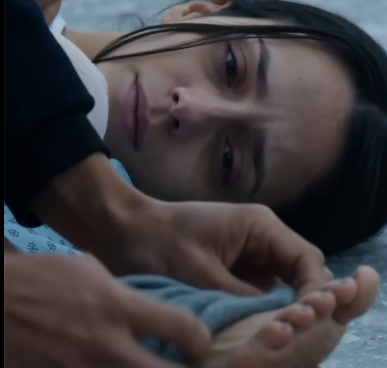
That was the thing. Not the cold, not the bare feet, not the January air — her eyes were dry. The eyes of someone who has gone past the place where crying lives and come out the other side into something quieter and much more frightening.
The flowers fell from his hand.
He didn’t notice. He was already moving.
— — —
He dropped beside her in one motion. His coat was off his back before his knees hit the ground — he didn’t deliberate, didn’t calculate, just pulled it off and put it around her shoulders with the efficiency of someone whose hands have decided to act while the rest of him is still arriving.
His scarf next. He unwound it and wrapped it around her feet. Her bare feet on the ice. His hands were shaking — he could feel them shaking — but they kept moving. That’s the thing about shock: it doesn’t always stop you. Sometimes it just makes you very focused on the next small thing.
She didn’t flinch. Didn’t thank him. Didn’t look at him.
Her eyes stayed on the middle distance, on something that wasn’t there.
“Lucía.” His voice came out low. The voice you use when you are controlling something very large. “What happened?”
She didn’t answer.
She held out her phone.
— — —
He read it the way you read something you have to read twice because the first time doesn’t make sense.
“The house isn’t yours anymore.”
“Don’t cause a scene.”
“I’ll prove you can’t care for the baby.”
Three messages. Sent in the hour after she had given birth. Sent while she was still in the bed, while the nurses were still in the room, while the baby was still finding its first sounds. Sent by the man who had stood beside her for two years and promised — in the particular way of people who are lying — everything.
He read them a second time.
Something in his face closed. Not with anger — or not only anger. With the specific expression of a person who has just understood the full shape of something, who is holding the whole picture for the first time and feeling its weight.
He handed the phone back.
“Where is he now?” Quiet. Very quiet.
She almost smiled. It was the saddest thing he had ever seen on a human face. “He told the nurses I was unstable. That I’d tried to leave with the baby without being discharged.” A pause. “So I left without being discharged.”
The baby made a sound then — small, newborn-indeterminate, a sound like a question. She adjusted her hold automatically, and for just a moment her face changed. Softened into something so raw and certain that he had to look away.
She loved this child with every cell she had. That was not in question.
“You’ve been out here how long?”
“A while.”
“Lucía.”
“Forty minutes. Maybe.”
He looked at her feet. At the ice. At the flowers lying scattered on the ground three feet away, yellow roses on gray concrete, petals already browning at the edges in the cold.
He took his phone out.
“I’m calling my sister,” he said. “She’s a family lawyer. Don’t say anything to anyone until she gets here.” He stood, shrugged off his jacket entirely — he was already coatless, he’d given that to her — and crouched back down to wrap it around the baby like a second layer. “And we’re going back inside.”
“They’ll say—”
“Let them say it.” His voice was steady now. The shaking had moved somewhere internal. “You just had a baby. You are not sitting on frozen concrete in January because someone sent you three text messages. That’s not how this ends.”
She looked at him for the first time since he’d arrived. Really looked — the way you look at someone when you’re deciding whether to trust them. Whether you have anything left to trust with.
He held it. Didn’t look away.
“I don’t have anywhere to go,” she said.
“Yes you do.”
— — —
He picked the flowers up off the ground on the way back in. Most of them were salvageable. The roses, especially — they’re tougher than they look.
He carried them in one hand. With the other, he held the door.
She walked through it.
Behind her, on the frozen pavement, the only thing left was the small hollow where she had been sitting — the shape of a woman who had decided, in the end, to get up.
Read the continuation in the comments.