
Innocent little girl asked, “Can I sit with you until my mom arrives?” The bodyguards prepared to act, but the billionaire tycoon said, “Just let her sit there”…. Then her mother walked in and saw the man sitting next to her daughter, she turned pale…
The child walked into the restaurant three minutes after the bomb threat.
That was what everyone would remember later, though no one said the word bomb out loud inside Belladonna’s. Not the maître d’ with the white gloves. Not the private security men pretending to be wine stewards. Not the deputy mayor, who had gone pale beneath her expensive makeup. Not the billionaire at table seven, whose name made grown men lower their voices in Manhattan.
They only said, “There’s been a call.”
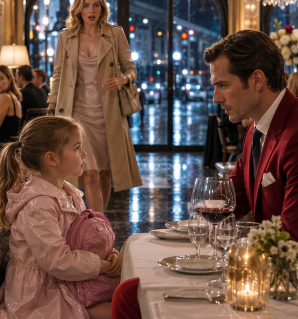
And then the rain-thin little girl in the red plastic raincoat pushed open the glass door by herself.
She was small enough to make the room go silent.
Five, maybe six.
Her hood had slipped back. Dark curls stuck to her cheeks. Her boots squeaked on the marble floor. In one hand she held a purple backpack by one strap as if someone had told her, very seriously, never to let it go. In the other she clutched a folded napkin from some cheaper diner, the kind with a crayon maze printed on the back.
Belladonna’s was not a place children entered alone.
It was a reservation-only Italian restaurant hidden behind smoked glass on East 61st Street, where actors came when they wanted to be seen pretending not to be seen, and politicians came when they wanted to make promises they could deny later. The chandeliers were low, the booths were private, and the wine list cost more than most people’s rent.
That evening, Belladonna’s belonged to one man.
Julian Blackthorne sat alone at table seven.
He had bought half the block through a legal trust, owned the restaurant through another, and controlled enough of New York’s private construction contracts to make newspapers call him a real estate king. Men who knew better called him something else.
The last Blackthorne.
The man who had inherited a criminal empire disguised as luxury developments, shipping warehouses, private security firms, and charitable foundations.
He wore a charcoal suit without a tie. His hair was dark, his face still, his eyes the gray of winter water. He had the kind of calm that did not soothe a room but disciplined it.
Two minutes earlier, his head of security had leaned down and murmured, “Anonymous warning. They named the restaurant. We’re clearing the kitchen and checking the service entrance.”
Julian had not moved.
“Quietly,” he said.
Then the child appeared.
Every man in Julian’s orbit reacted before thinking. One reached toward his jacket. Another stepped subtly away from the bar. The maître d’ froze with his hand on the reservation book.
But the girl did not look afraid.
She stood in the doorway, dripping rainwater onto the floor, and studied the dining room as if she had walked into the wrong classroom and was deciding which adult looked most likely to know the answer.
Then she walked straight toward Julian Blackthorne.
The security men moved.
Julian lifted two fingers.
They stopped.
The girl reached table seven and looked at the empty chair across from him.
“Excuse me,” she said.
Her voice was small, clear, and practical.
Julian looked down at her.
“Yes?”
“Is anybody sitting there?”
“No.”
“Can I sit there until my mom comes back?”
The room held its breath.
Julian Blackthorne looked at the child, then at the wet glass door, then at the service hallway, where two of his men had vanished toward the kitchen.
“Where is your mother?” he asked.
“In the bathroom.” The girl pointed vaguely behind her, though she had clearly come from outside. “She said to wait somewhere safe. But all the other chairs have grown-ups.”
“Did she bring you here?”
The girl hesitated.
It was almost nothing. A tiny pause. But Julian saw it.
“My mom says you don’t have to tell strangers everything,” she said.
A faint, dangerous amusement moved behind Julian’s eyes.
“Smart mother.”
“She is,” the girl said.
“What’s your name?”
“Maya.”
“Last name?”
Her little chin lifted.
“My mom says that’s a stranger question.”
This time, Julian almost smiled.
Not fully. Not enough for anyone else in the restaurant to be sure. But the corner of his mouth changed, and the woman at table nine saw it.
Sloane Avery had spent nine years watching Julian Blackthorne’s face for signs of disaster. She had served as his external counsel, crisis manager, fixer, and, for a period neither of them named anymore, something dangerously close to the only person he trusted. She had seen him watch judges lie, rivals beg, and brothers betray him.
She had not seen that expression in seven years.
Not since a woman named Hannah Mercer had disappeared from Chicago with one suitcase, a nursing school acceptance letter, and a secret Sloane had helped bury.
At table seven, Julian pulled the chair back.
Maya climbed onto it and placed her backpack carefully on her lap.
“I’ll be quiet,” she promised.
“I doubt that,” Julian said.
Maya blinked, then decided he was not being mean.
“I can be quiet when I want to.”
“That is a rare talent.”
“My kindergarten teacher says I have selective quiet.”
“That sounds serious.”
“It means I talk too much when I care about something.”
Julian leaned back.
“What do you care about?”
—————————————————
Say “suggestion” – Part 2 will be updated below 👇