
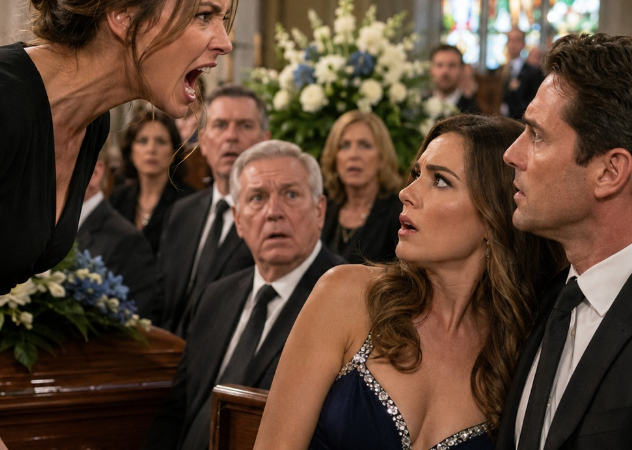
My husband’s mistress wore my missing Versace dress to my father’s funeral. Sat in the family row. Held my husband’s hand. And an hour later, my father’s lawyer began the will with, “”To my daughter Natalie, who called me yesterday about her husband’s affair…””
My Versace dress had been missing for three weeks, and until that morning, I thought that was the ugliest mystery in my life.
It was midnight blue, the kind of blue that looked black in shadow and silver where the hand-sewn crystals along the neckline caught the light. My father had given it to me for my fortieth birthday last fall with a card that said, For the nights when you want to remember that elegance is armor. He wrote like that, half lawyer, half poet, fully convinced that style could save a woman if she wore it correctly.
I tore through every closet in the house looking for it the week before the funeral. Garment bags, cedar chest, hall closet, guest room, even the trunk of my car. I accused the dry cleaner, dumped old shoe boxes onto the bedroom floor, and breathed in dust, leather, and stale perfume until my eyes burned. Nothing.
By the morning of the service, grief had shoved everything else to the edge. My father was gone. The house was full of casseroles, white lilies, and coffee that had been sitting on a burner too long. People stood in my kitchen speaking in low voices and touching my wrist when they talked, as if I might shatter in their hands.
I wore black because black was simple and I didn’t trust myself with anything delicate.
St. Augustine’s Cathedral was cool and dim when I stepped inside, all marble, candle wax, and stained glass. The organ was already murmuring under people’s conversations. There were polished shoes on stone floors, damp tissues, loosened ties, and that heavy hush rich families call dignity when what they really mean is disaster in public. My father had known half the city, and apparently all of them had come.
I stopped at the back for a second just to breathe.
At the front, my father’s casket rested beneath white roses and blue delphiniums. Father Martinez was speaking quietly to Mr. Blackwood, Dad’s attorney and oldest friend. My aunt Helen was directing relatives with the focused expression of a woman prepared to personally throw chaos down a staircase if it tried her.
Then I saw my husband.
Grant was seated in the front row where he belonged, except he wasn’t alone.
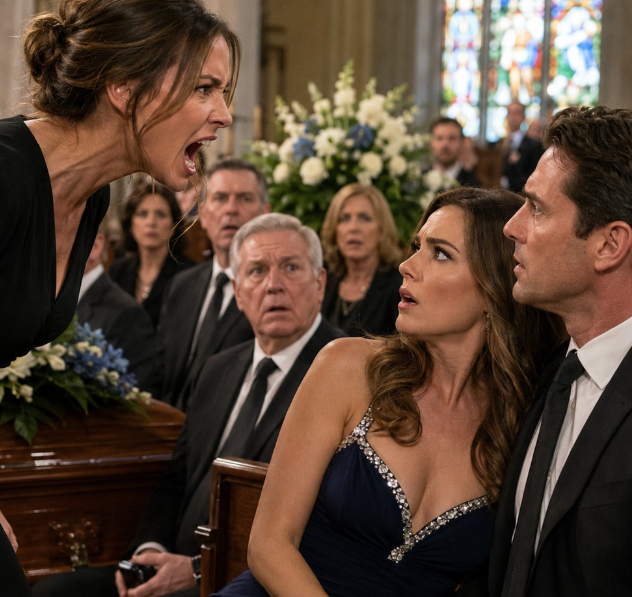
The woman beside him was wearing my dress.
For one bright, stupid second, my mind refused to make sense of it. All I could do was stare at the crystals flashing under the stained glass as she turned her head. Red and blue light scattered across the pew in front of her. My father used to joke that the dress looked expensive enough to make its own weather. There it was, glittering from another woman’s body while he lay dead twenty feet away.
My feet started moving before I had decided whether I was about to speak or scream.
“”Becca,”” I said, and my own voice sounded flat and strange in my ears. “”What the hell are you doing here?””
Rebecca Thornton turned around with the smoothest smile I had ever wanted to slap off a face.
She was twenty-eight, maybe twenty-nine on a forgiving day, and worked in marketing at Grant’s firm. I had met her twice at company events. She had glossy brown hair, expensive cheek filler, and a talent for standing just a little too close to married men. Both times she had called me Natalie in that overly warm way women do when they want credit for friendliness without the burden of sincerity.
“”Natalie,”” she said softly, like we were meeting for brunch and not over my father’s coffin. “”I’m so sorry for your loss.””
She had one hand wrapped around Grant’s.
My husband finally looked up at me, and the expression on his face hit harder than a slap.
It wasn’t confusion. It wasn’t shock. It was guilt.
The whole cathedral seemed to pull tight around my ribs. The air smelled suddenly metallic, like I’d bitten the inside of my mouth. Every late meeting, every conference, every trip cut short with a vague excuse about clients or flights began lining up in my head so fast I almost got dizzy. Even the missing dress suddenly made sense in the cruelest way possible.
“”Why is she wearing my dress?”” I asked.
Nobody answered right away, which was answer enough.
Rebecca crossed one leg over the other and the hem shifted against her knee. I knew that dress well enough to see, instantly, that she had had the waist taken in.
“”Oh, this?”” she said, touching the neckline like it belonged to her. “”Grant gave it to me. He said you never wore it.””
I looked at my husband.
His gaze dropped so fast it might have been funny in any other life. Fifteen years of marriage, and he still thought refusing eye contact counted as a strategy.
“”Tell me she’s lying,”” I said.
“”Natalie,”” he muttered, leaning forward, voice low and urgent, as if I was the one about to embarrass him in church. “”Not here.””
The words landed harder than if he had shouted. Not here. As if the problem was my timing and not his mistress in my father’s front pew wearing my birthday gift.
Across the aisle, Aunt Helen had gone perfectly still. Near the altar, Mr. Blackwood turned at the sound of my voice, and I saw something in his hand: a thick cream envelope with my father’s handwriting across the front. For the first time that morning, Rebecca’s smile faltered.
And in that moment, standing between my father’s casket and my husband’s betrayal, I understood that the missing dress was never the whole story.