
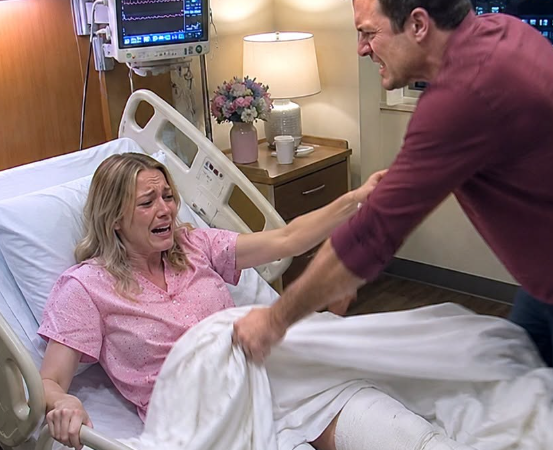
After a terrible car accident, I was rushed straight to the hospital. My husband stormed into my room in a rage. “Enough with this performance!” he shouted. “Get out of that bed—I’m not wasting my money on you!” He grabbed me and tried to drag me off the mattress. When I fought back weakly, he slammed both fists into my stomach. What happened next was beyond anything I could’ve imagined…
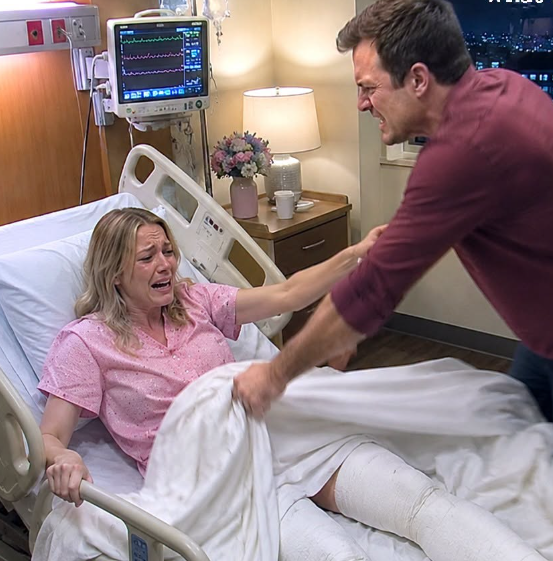
The room smelled like antiseptic, cold coffee, and the faint plastic scent of new bandages. Every few seconds, the monitor beside my bed gave one soft beep, steady enough that I had started measuring my fear by it.
Beep.
Breathe.
Beep.
Don’t cry.
The fluorescent light above me buzzed against the ceiling. My legs were locked in plaster casts from my thighs down, heavy as concrete, and the thin hospital blanket scratched against my skin every time I tried to shift.
Three weeks earlier, a speeding car had turned a normal afternoon into flashing lights, broken glass, and a hospital intake form stamped 6:42 PM.
For twenty-one days, I had waited for Caleb to walk through that door like a husband.
He came in like a bill collector.
“Stop this drama, Rebecca,” he snapped from the foot of my bed, wearing a pressed shirt and expensive cologne. “Get up. We’re leaving.”
I stared at him through the medication haze.
“Caleb, I can’t.”
His mouth tightened.
“Don’t start.”
“My legs are broken.”
“I heard the doctors.” He leaned over the rail, close enough that I could smell mint gum under his anger. “I also heard the hospital intake desk ask about payment again. I’m done wasting money on this performance.”
Performance.
I had not performed the cracked ribs. I had not performed the stitches under my hairline. I had not performed the patient wristband cutting into my swollen wrist or the room chart clipped outside the door with my name, Rebecca Walker, typed in black ink.
But Caleb had always been good at turning my pain into an inconvenience.
We had been married eleven years. I left my accounting job when Emma was little because Caleb said our daughter needed one parent steady at home. I packed his lunches, paid the bills from the kitchen table, sat through parent-teacher conferences alone, and learned which silence kept the house peaceful.
A woman can mistake peacekeeping for love for a long time. Then one day, she stops moving, and everyone notices she was the furniture.
“I gave up everything for this family,” I said, barely louder than the monitor. “You are my husband. You’re supposed to help me.”
His eyes did not soften.
They narrowed.
“Help you?” he said. “You’re a burden.”
The room went still except for the beeping.
Not sick.
Not injured.
Not his wife.
A burden.
He grabbed the blanket first, yanking it down like he could pull dignity off me with one hand. Then his fingers closed around my upper arm.
I tried to brace myself against the mattress, but my hands shook so badly my wedding ring clicked against the metal bed rail.
“Caleb, stop,” I whispered.
He pulled harder.
Pain shot through my ribs and up into my throat. My casts dragged an inch against the sheet, and the monitor changed rhythm, faster now, sharp little alarms stacking on top of each other.
“Get out of that bed,” he hissed. “I’m not paying for a wife who can’t even be useful.”
Something hot and ugly rose in me then.
I did not slap him. I did not scream back. I did not say the things that had lived behind my teeth for eleven years.
I only held the rail with both hands and said, “No.”
For one second, he looked stunned, as if the bed itself had spoken.
Then he swung both fists down into my stomach.
The pain was white and total. My breath vanished. My whole body folded as much as the casts would allow, and the scream that tore out of me sounded like it belonged to someone in another room.
The monitor broke into a frantic alarm.
Outside the door, the visitor log had his name on it. The room chart had mine. The nurses’ station had the intake timestamp, medication record, and fall-risk warning taped in bright yellow beside my file.
Every system in that hospital had recorded me as a patient.
Caleb was the only person still trying to record me as a problem.
He leaned over me, red-faced, one hand gripping the blanket, his other fist already rising again.
“You don’t get to talk back to me,” he said. “Do you understand?”
I looked past him toward the door.
The hallway beyond it was too quiet, too clean, too normal. Somewhere out there, a nurse was pushing a cart. Somewhere, someone was laughing softly near the nurses’ station. Somewhere, my daughter Emma probably thought her father was visiting her mother with flowers.
But in that room, Caleb’s shadow covered the bed.
My fingers tightened around the rail until my knuckles burned.
I thought about surviving the crash.
I thought about waking up under surgical lights.
I thought about Emma’s drawing taped to the wall beside my bed, the one that said, Come home soon, Mommy.
Then Caleb drew his fist back one more time.
The monitor screamed.
And just as his arm started to come down, the silver handle on my hospital door began to turn—— (Full Details Below

) Have a great time, everyone!