My parents walked into federal court believing they were there to save their son and finally bury the daughter they’d spent ten years calling a Navy disgrace. Then the courtroom doors opened, my white ceremonial uniform caught the light, and my brother whispered, “No… this can’t be happening,” because the sister he had erased was about to become the government’s most dangerous witness.
That Tuesday morning, the federal courthouse smelled like polished marble, burned coffee, and fear hidden beneath expensive cologne. My brother Luke sat at the defense table in a navy suit, shoulders squared and jaw tight, wearing the same trustworthy expression that had convinced lenders, neighbors, and half the county to believe in Vance Shield Recovery.
Behind him sat my parents, Bernard and Celina Sterling, dressed as though respectability might still save them. Mom clutched her purse with both hands while Dad stared toward the judge’s bench, unaware that I was already inside the building.
For ten years, they had lived inside Luke’s version of my life. According to him, I had broken under pressure, washed out of the Navy, disappeared in shame, and eventually begged him to protect the Sterling family name.
He repeated those lies until my parents stopped hearing them as lies. Somehow, believing their daughter was a failure became easier than questioning their golden son.
I was nineteen when I told them I wanted to enlist, and Dad warned me not to start something I couldn’t finish. The cruelest part was that I did finish, through brutal training, sleepless nights, and work that taught me how to remain steady while everything around me was falling apart.
Luke needed me broken because my success made him feel smaller. So he forged emails from my old account, created convincing discharge papers, drained savings I’d left untouched, and maneuvered his way into our grandfather’s marshland.
At charity dinners and contract meetings, my supposed disgrace became part of his story. Luke became the dependable Sterling child, while I became the cautionary tale people whispered about.
My parents didn’t merely believe him. They protected him.
The last time I came home wearing the very uniform Luke claimed I had disgraced, Dad looked at the forged documents on his desk, then looked directly at me, and chose Luke anyway. Mom’s only question was whether I had come back because I needed money.
That night, something inside me finally went quiet. I stopped begging my own family to see me.
Years later, during a federal review of storm-recovery contracts, Vance Shield Recovery appeared in a file routed across my desk. Veteran-preference status, 51 percent veteran-linked ownership, verified service history, honorable separation, and a hardship narrative attached to the name C. Sterling.
Every line came from me.
My copied signature. My service history. My identity.
Luke had turned the fictional death of my reputation into a federal income stream, and when investigators pulled at one thread, the entire family web began unraveling. They found my parents’ signatures on guarantees, pledged assets, and retirement funds tied to fraud they believed was protecting their son.
When the government asked whether I would testify, my answer was simple: yes. Not because I wanted revenge, but because a lie shouldn’t be allowed to outlive the person it tried to bury.
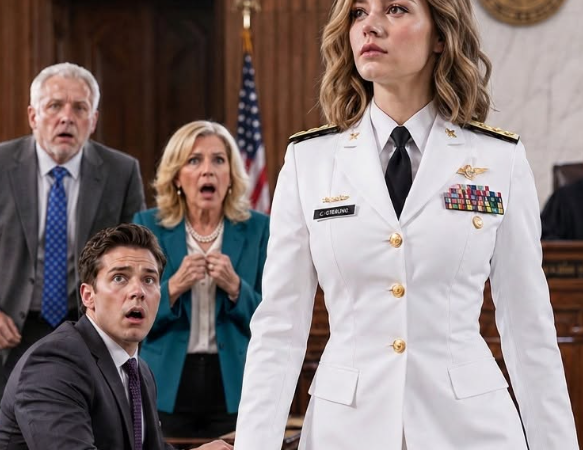
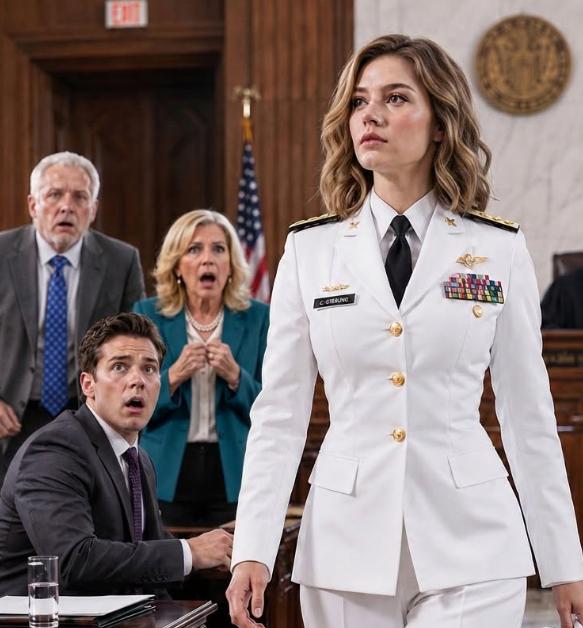
My parents arrived expecting the weak, bitter daughter Luke had created for them. Instead, the prosecutor stood, the rear doors opened, and my shoes struck the marble floor as I entered in full ceremonial uniform.
Mom’s purse crashed to the floor.
Dad rose halfway from his seat, frozen between pride and terror, while Luke slowly turned around. His eyes traveled from my white uniform to my medals, then finally to my rank, and for the first time in twelve years, I watched certainty disappear from my brother’s face.
The courtroom fell completely silent.
The prosecutor lifted a thick folder, turned toward me, and said, “Please state your name and title for the record.”
READ THE REST OF STORY IN THE COMMENTS