
“For two winters, I allowed a homeless runaway boy to sleep in the back room of the gas station where I worked overnight. My manager fired me in front of the customers. “”You’re a thief,”” he said. Six years later, on the very morning I was being evicted, that same boy appeared at my door. And he had brought someone with him.
My son, Jesse, disappeared from home when he was sixteen.
That was eleven years ago this March.
He’d left a message on our kitchen table that read, “”I’m sorry, Mom. I’ll only drag you down.””
I never managed to find him. I contacted every shelter between Duluth and Seattle. I made so many missing-person flyers that the workers at the print shop recognized me.
After losing my husband, I started working overnight at the Gas-N-Go along Highway 53, mostly because sleeping had become impossible anyway.
That was where Danny entered my life.
He looked about fifteen. Thin and underdressed, wearing nothing but a hoodie in January, despite temperatures reaching twenty below zero.
Every night around 2 a.m., he’d enter the store and linger beside the coffee machine, acting as though he were studying the labels.
He never purchased anything.
On his third visit, I offered him a hot dog and some warm cocoa.
“”On the house,”” I said.
He stared at me with the expression of someone who hadn’t experienced kindness in ages.
It reminded me painfully of the way Jesse used to look at me.
So I broke a rule I knew I shouldn’t.
I allowed Danny to spend the night in the storeroom behind the counter, tucked between stacks of paper towels and bottles of windshield fluid. I gave him a sleeping bag and brought over Jesse’s old Carhartt coat from my hallway closet.
“”It’s too big,”” Danny said.
“”You’ll grow into it,”” I told him.
Throughout the next two winters, he stayed there between midnight and six in the morning. He mopped and swept the floors, refilled the refrigerated displays, and never touched anything without permission.
Then, one morning, Doug Pruitt, the station manager, showed up earlier than usual.
He opened the storeroom and discovered Danny sleeping on the floor.
Grabbing the back of his hoodie, Doug hauled him into the store in full view of the morning shoppers.
“”You’re running a homeless shelter on my dime, Marlene?”” he yelled.
“”He’s a kid, Doug. He has nowhere to go.””
“”He’s a junkie,”” Doug said. “”And you’ve been feeding him my hot dogs. That’s stealing.””
Everyone watched in silence. One customer wearing a Vikings baseball cap set his coffee down and left.
“”I’ll pay for every hot dog,”” I said.
“”You’ll pay, all right,”” Doug said. “”You’re fired. Get out before I call the cops. And don’t bother asking anybody in Duluth for a reference. I’ll make sure they know you’re a thief.””
Danny turned toward me, his eyes filling with tears.
“”I’m sorry, Mrs. K.””
By that evening, he had disappeared.
Jesse’s jacket had vanished with him.
Only a week afterward did I remember that the last photograph I possessed of my son was tucked inside its inner pocket.
I spent the following month crying.
It wasn’t losing my employment that broke me.
It was losing the final photograph of my own child, along with the boy I’d desperately tried to protect in his absence.
Another six years passed.
I earned money cleaning motel rooms. My health deteriorated, and I struggled to keep up with the rent.
Last autumn, the duplex I’d been renting was purchased by a different landlord.
Doug Pruitt.
He had acquired nearly half the block.
“”Six years of late rent, Marlene,”” he said, smiling, when he attached the eviction notice to my front door. “”Friday. Pack your junk or the sheriff does it for you.””
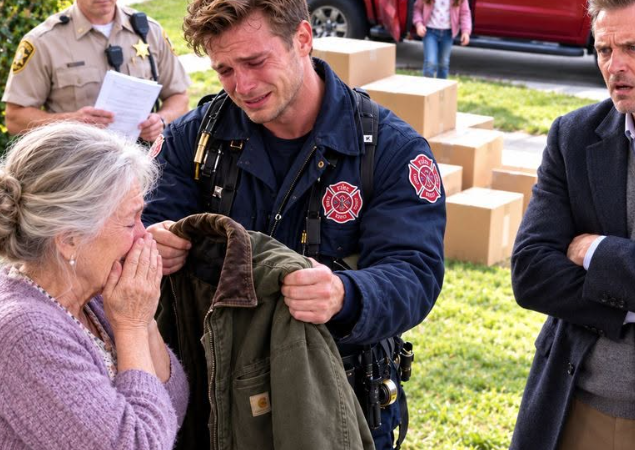
That Friday morning, a sheriff’s deputy arrived on my porch carrying an eviction order. Doug stood next to him, arms folded across his chest, while neighbors peered out through their windows.
Everything I owned had been packed into nine cardboard boxes scattered across the grass.
“”Let’s go, Marlene,”” Doug said. “”I’ve got painters coming at noon.””
“”Okay,”” I said. “”Just let me get my husband’s picture off the wall.””
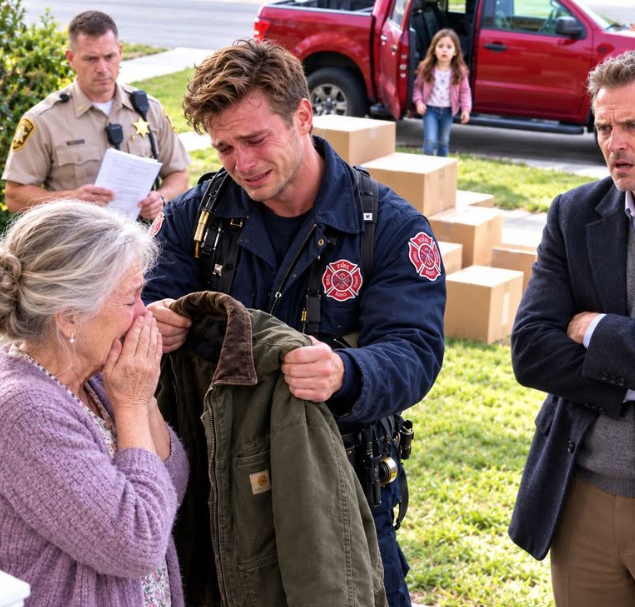
At that exact moment, a red pickup pulled alongside the curb.
A tall young man stepped out, dressed in a jacket bearing the Duluth Fire Department insignia.
He climbed my porch steps, walked straight past Doug and the deputy, and came to a halt before me.
“”Mrs. K,”” he said. “”I’m so sorry it took me this long.””
It was Danny.
No longer a skinny teenager, but a grown man with broad shoulders and tears streaming down his face.
In his hands, he carried Jesse’s old Carhartt jacket.
“”I need to tell you something,”” he said. “”And I need you to sit down first.””
Behind him, the pickup’s passenger door swung open.
And the little girl who stepped out had eyes exactly like my son’s.”