The last time I saw my parents, my mother pressed a plastic container of chicken soup into my hands as if it were a medical prescription.
The lid was still warm, beaded with condensation, and the scent of garlic clung to my coat.
“You’re too thin. Don’t argue with me. Just take it.”
I laughed, kissed her soft cheek, and promised I’d be back the following weekend.
I meant it.
But life always makes noise when it’s stealing your time.
Work ran late. There was a birthday dinner. A flight got canceled. I caught a silly cold that made my bones ache.
One common excuse led to another, until a whole week stood between what I promised and what I actually did.
So when Kara texted me on Tuesday at 5:18 p.m.—“Can you swing by Mom and Dad’s place and grab the mail? We’ll be away for a few days. Don’t forget the basement door sticks”—guilt struck me, swift and sharp.
It sounded harmless.
A simple errand.
A bag of mail.
A small chance to prove that I hadn’t become the kind of daughter who loves people only when it’s convenient.
I wrapped up a call with a client and grabbed a grocery bag filled with things they loved: seedless grapes, the expensive butter Dad insisted tasted exactly the same as the cheap stuff, and a loaf of freshly baked sourdough bread that filled the entire car with a warm, yeasty aroma.
By 6:04 p.m., I was already driving across the city as twilight drained the color from the sky. Their neighborhood always seemed like a preserved version of my childhood.
Trimmed hedges.
Maple branches arching over the street.
Porch lights switching on one by one, like small, patient signals.
But when I pulled into their driveway, something inside me went still.
Dad’s garden hose was coiled too perfectly.
The porch swing wasn’t moving.
My mother’s silver wind chimes hung in silence, even though a thin spring breeze was drifting across the yard.
The house didn’t look empty.
It looked locked from the inside.
I rang the doorbell.
Nothing.
I knocked harder.
“Mom? Dad? It’s me.”
Still nothing.
For a second, I tried to make it seem normal.
Maybe they had gone out.
Maybe Kara had meant that everyone was away.
Maybe they were at some resort where people wear white robes and pretend that cucumber water counts as happiness.
But Mom’s little blue car was still in the driveway, the dent above the rear tire reflecting the porch light.
Dad’s truck sat at its usual lazy angle, as if even gravity had given up trying to correct it.
I slid my key into the lock.
The click sounded obscene in that silence.
The moment I opened the door, I knew.
The house didn’t smell of rot.
It didn’t smell of smoke.
It smelled of stale air—metallic and exhausted, as if it had been breathed too many times.
A lamp glowed in the living room, spilling yellow light onto the rug.
The TV was off.
My mother hated a silent house; she always had some talk show or cooking segment on, even if she wasn’t watching it.
I took two steps and stopped so abruptly that my shoulder slammed into the doorframe.
They were on the floor. My mother lay on her side near the coffee table, one arm extended forward as if she had tried to reach for something and simply stopped.
My father lay on his back beside the sofa, his mouth slightly open and his glasses askew, halfway down his face.
For an impossible second, my brain refused to translate the scene.
I stared at my mother’s hand—her pale knuckles, her wedding ring catching the light from the lamp.
“Mom?”
My voice sounded weak, almost childlike.
The grocery bag slipped from my hand.
Grapes rolled out, skittering beneath the side table like green marbles.
I knelt beside her and touched her cheek.
Cold.
Not the cold of death.
Not yet.
But the kind of cold that makes your body recoil before your mind even understands why.
“No. No, no, no.”
I shook her shoulder—gently at first, then harder.
“Mom, wake up. Please. Please, wake up.”
Nothing.
I crawled over to Dad and pressed two fingers against his neck—the way people do on TV when they still believe that panic might actually help.
For one terrible second, I felt nothing.
Then, there it was.
Faint.
Threadlike.
Trembling beneath his skin.
My rage didn’t come hot.
It turned cold.
I wanted to scream loud enough to crack the walls, but all that escaped was air through clenched teeth.
I called 911 at 6:41 p.m.
The call log would later say: two unconscious adults, possible exposure, daughter on scene.
At that moment, all I could hear was the dispatcher’s voice telling me to count Dad’s breaths while my hands shook so much I almost dropped the phone.
The refrigerator was whirring.
The clock was ticking.
Somewhere in the kitchen sink, a drop of water fell over and over again.
I couldn’t stop thinking about Kara’s message.
“We’ll be gone for a few days. Don’t forget the basement door sticks.”
People think betrayal comes with shouting, but sometimes it comes disguised as a practical reminder.
A sentence.
A task.
A door you were told to watch out for.
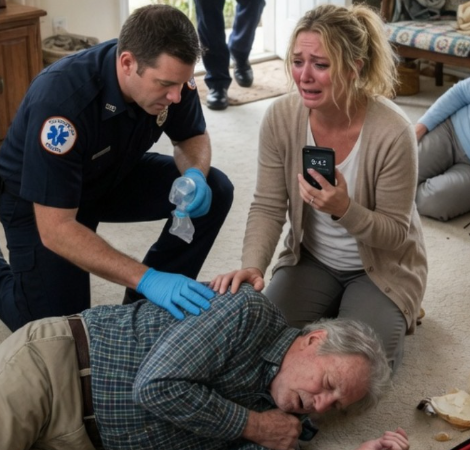
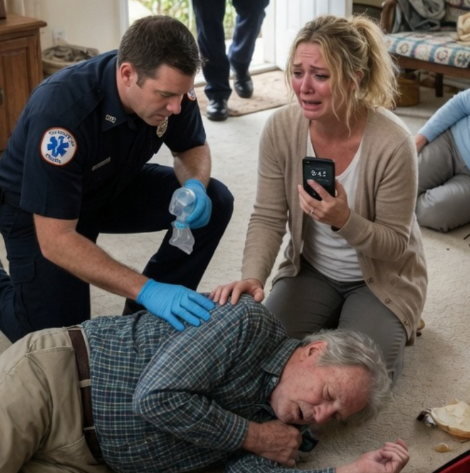
The paramedics arrived amid flashing red lights and radio static.
One of them knelt beside Mom.
Another broke the silence with short, pointed questions.
Another asked if there were chemicals in the house, if the heating was in the basement, if anyone else had been inside.
I answered as best I could, but my eyes kept returning to the coffee table, where my mother’s hand had frozen just inches from the phone.
At St. Agnes Regional Hospital, the emergency room admission form listed them both as unconscious upon arrival.
The first toxicology report came back marked as urgent.
A doctor with tired eyes led me down a hallway that smelled of disinfectant and burnt coffee, and said the word I dreaded hearing.
“Poisoned.”
Not food poisoning.
Not fainting.
Not two elderly people forgetting to eat.
Poisoned.
Clean.
Doctor.
Definitely.
My husband arrived ten minutes later and found me sitting in the light of a vending machine, my coat still smelling of sourdough bread and garlic.
He didn’t tell me to calm down.
He didn’t tell me to stop imagining things.
He took the phone from my hand, read Kara’s message, and then read it again.
A week later, when Mom and Dad were breathing on their own but still too weak to explain anything, he came back to the house with the 911 report, the hospital toxicology report, and a screenshot of Kara’s 5:18 p.m. message printed on a single sheet of paper.
He said he just wanted to check the basement door.
I stood behind him in the hallway while the house retained that same stale silence.
He grasped the basement doorknob and paused.
His thumb traced a pale mark near the latch, fresh on the old brass.
On the floor, beneath it, was something I had stepped on that first night without noticing.
A tiny torn corner of blue paper.
My husband bent down, picked it up, and stood so still it made my stomach churn.
The instant he saw what was printed on that scrap of paper, he understood that Kara’s message concealed much more than a stuck basement door…
What happened when he opened that door is in the comments.