
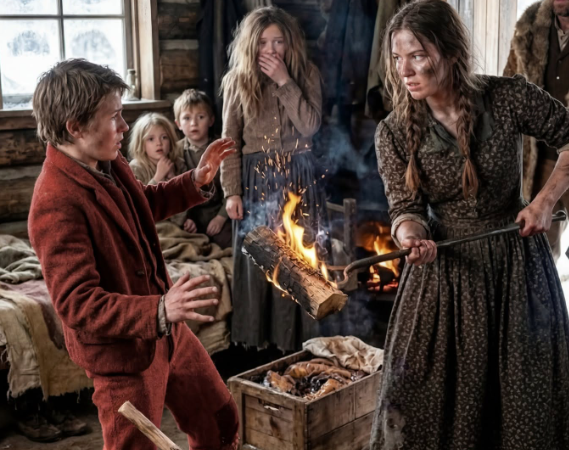
“She’s Worth Three Sacks of Wheat,” Her Father Said – But the Mountain Man with Five Children Watched Her Become Priceless
Kora was nineteen when her father priced her like something stacked beside the flour barrels.
Three sacks of winter wheat.
One forgiven gambling debt.
That was what Arthur took for his daughter in the back room of Red Creek’s general store, where the floorboards smelled of dust, lamp oil, and old tobacco, and the cold kept slipping under the door like it wanted to hear the bargain too.
The storekeeper did not look at her. Her father did not look ashamed. The man who accepted her stood beside a crate of nails with a wolf-hide coat on his shoulders and five hungry children waiting somewhere up in the timber.
His name was Gideon.
People in town called him half-wild, though never when he was close enough to hear it. He had hands like axe handles, a dead wife, and a cabin no woman in Red Creek would step inside unless hunger drove her there first. He did not look at Kora like a bride. He looked at her the way a man looks at a tool on a shelf, wondering whether it will hold up long enough to be worth carrying home.
Arthur signed nothing, because men like him did not need paper when shame would do the binding. The storekeeper marked the wheat against the ledger at 4:17 that afternoon, and Gideon took the reins before the sky went iron gray.
Kora climbed into the wagon with her bundle in her lap.
Her father said, “You’ll be better off.”
She waited for him to say something else. A blessing. An apology. Her name.
He only snapped the reins and turned his face away.
The road to Gideon’s cabin climbed into the high timber, where the wind bit through her thin sleeves and the pines closed around the wagon like dark ribs. Snow crusted the ruts. The mule’s breath steamed white. Somewhere behind them, Red Creek disappeared one roof at a time, and Kora understood that a town could watch a girl be sold and still go on selling molasses, calico, and coffee as if nothing had happened.
Cruelty rarely needs a courtroom. Sometimes it only needs three men in a store and a girl too cold to scream.
When they reached the cabin, Gideon did not help her down. He lifted the latch, pushed the door open, and the smell struck her before the darkness did.
Unwashed bodies. Sour bedding. Rendered fat gone bad. Smoke sunk deep into dirty walls.
Kora pressed one hand to her stomach.
Then the children stared out from the shadows.
Five of them.
Caleb, the oldest boy, stood near the hearth with a piece of kindling clenched like a club. He could not have been more than fourteen, but grief had already made his shoulders hard. A twelve-year-old girl watched from behind him, hair tangled around a face that had learned not to soften. The smaller ones clung to her skirts and to each other, hollow-eyed, silent, and suspicious.
“This is Kora,” Gideon said. “She’s staying.”
That was all.
No promise. No welcome. No warning.
He took his axe from the wall and walked back outside, leaving Kora alone with five children who looked at her as if she had stolen their mother’s place and brought nothing worth eating in return.
Caleb spat on the floor, close enough that it landed inches from her boots.
Kora looked at the spit. Then at him. Then at the little ones behind him, with cracked lips, dirty cheeks, and the kind of fear that had learned to bite first.
Every story she had ever read said this was where she should kneel down, open her arms, and win them with patience.
Instead, she ran outside and vomited behind the woodpile.
She was not a saint. She was a sold girl in a freezing mountain cabin, and for one ugly moment, she hated every soul under that roof.
The first week passed in smoke, silence, and small cruelties.
At 5:30 each morning, Gideon left with his traps or his axe. At dusk, he came back carrying meat, wood, or nothing at all. Kora learned where the flour sack was kept, where the cracked tin cups hung, which blanket smelled worst, and which floorboard groaned if she stepped on it after dark.
She boiled water until her fingers went numb. She scraped old grease from a skillet with a dull knife. She found one wooden spoon under a bed, two socks frozen stiff beside the door, and a dead mouse in the flour bin.
The children did not thank her.
Caleb watched every movement. If she touched the stove, he shifted. If she reached for the baby, he stepped between them. The twelve-year-old girl, Mae, answered every question with either silence or a stare sharp enough to cut thread. The three little ones followed orders only when fear was louder than hunger.
By the seventh day, Kora had made a list in her head: bedding to wash, ash to clear, food to sort, water to boil, children to keep from biting one another like trapped pups.
No document could have proved her work. So she made proof with process. She sorted what could be eaten from what had gone bad. She aired what could be saved. She carried the worst bedding outside in frozen arms and beat it against a rail until dust rose in gray clouds.
That was when she found the crate.
It sat half-hidden beneath a torn quilt near the back wall, covered with a warped board and a slick cloth. The smell around it was heavier than the rest of the cabin, thick enough to coat her tongue. When she lifted the cloth, the sour stink rolled out so hard her eyes watered.
Rancid bear fat.
A whole crate of it, yellowed and sweating in the cold, left too close to the sleeping corner where the smallest child coughed through the night.
Kora looked at the baby’s gray little face. Then she looked at the crate again.
Some homes fall apart from poverty. Some fall apart because grief sits down in the middle of the floor and no one dares move it.
She dragged the crate toward the door.
Caleb hit her shoulder before she made it two feet.
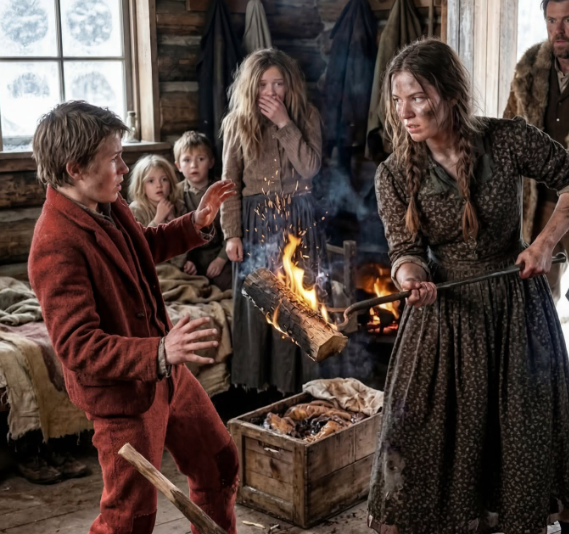
The shove caught her off balance and threw her hard onto the plank floor. Pain flashed through her hip. Her palm slid through ash. The little ones gasped, and Mae’s hand flew to her mouth before she could hide it.
“Don’t touch that,” Caleb said.
Kora stayed still for one breath.
Then another.
The fire cracked in the hearth. Outside, Gideon’s axe stopped mid-swing.
Kora rose slowly, ash on her sleeve, her braid loose against her cheek. Her hands were shaking, but not from fear anymore. She reached into the hearth and took hold of a burning log with the iron hook, lifting it until sparks snapped orange against the cabin’s dim air.
Caleb’s face changed.
So did Mae’s.
Even Gideon appeared in the doorway, axe in one hand, watching as the girl he had bought for three sacks of wheat turned toward his oldest son with fire in her grip and said—