
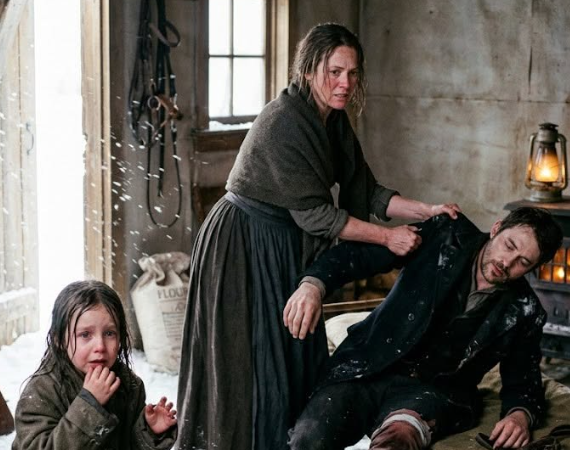
A Little Girl Begged Outside Abigail’s Cabin in a Blizzard — “My Daddy Can’t Wake Up”
Abigail Turner had the barrel of her grandfather’s rifle pressed against the cabin door when the wind started screaming like it wanted inside. Snow scraped the walls in hard white sheets, the stove snapped behind her, and the old floorboards felt cold even through her socks.
She told herself she would not open that door.
Not for a stranger. Not for a sob story. Not for another voice in the dark asking her to believe kindness was still safe.
She had believed that once, and it had cost her nearly everything.
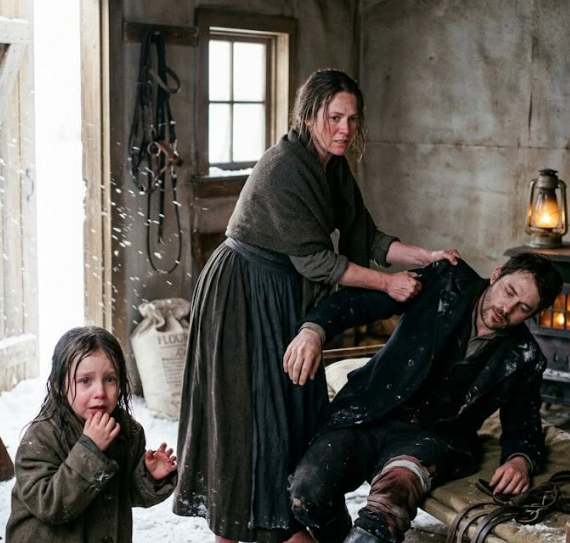
Then something heavy hit the porch.
A second later, a child’s voice cut through the storm.
“Please,” the little girl cried. “My daddy can’t wake up.”
Abigail stood still with both hands on the rifle. Three seconds passed. She knew because her eyes flicked to the little clock above the shelf, the one that had stopped twice that winter and still somehow kept time when it mattered.
Three seconds was long enough for every hard lesson in her life to stand up and speak at once.
Doors were how trouble entered.
Mercy was how lonely women got used.
And still, Abigail opened it.
She did not lower the rifle right away. A woman alone in a Montana blizzard did not swing her door wide and stand there empty-handed like the world had never taken a swing at her. You opened ready. You breathed ready. You hoped you were wrong and prepared like you were not.
What she saw froze her colder than the wind.
A black horse had collapsed against the porch rail, its legs folded wrong beneath its body. Beside it, half buried in snow, lay a big man in a dark coat, one hand still tangled in the reins as if he had tried to hold on until his body simply quit.
And standing over him was a little girl no older than six, swallowed by a coat two sizes too big, her soaked boots planted in the snow, her dark hair plastered to her cheeks.
Her eyes were enormous.
They looked at Abigail like she was either an answer to prayer or the last face that child would ever see.
“He fell off,” the girl said, too frightened to even shake. “He couldn’t hold on anymore, and he fell, and I tried to wake him up. I tried a lot of times.”
Abigail thought about the promise she had made herself. No strangers. No soft spots. No letting need walk through her door and rearrange what little life she had left.
Then she stepped onto the porch in her bare feet, and the snow bit straight through her socks.
“Get inside,” she told the girl. “Right now. Stand by the stove. Don’t touch anything.”
“But my daddy—”
“I’ll get your daddy. Go.”
The child obeyed.
Abigail crouched beside the man and grabbed his collar. He was heavy in the way working men got heavy, not soft, but dense, built out of muscle, weather, and years of not asking for help. She hauled him the way she had hauled feed sacks, fence posts, injured calves, and every other burden the world had dropped at her feet.
By 9:17 that night, Ethan Callaway was on her cot near the stove.
She learned his name from the child, Rosie Callaway from Texas, who said it the precise way children repeat emergency instructions they have been told too many times.
“My daddy owns the Callaway ranch,” Rosie said. “It’s very big. He said if anything happened, I was supposed to tell people that.”
Abigail filed it away.
She noticed the expensive coat first. Then the torn right leg of his trousers. Then the bandage wrapped beneath, soaked dark and ugly.
The smell reached her before she unwrapped it.
Infection.
“That’s bad,” Abigail said.
Rosie had left the stove and come up beside her, exactly where she had been told not to be. “Is he going to die? You can tell me. I’m not a baby.”
Abigail looked at the child, then at the man burning up on her cot.
“Not if I can help it.”
She took down her old medical kit, the one with clean cloth, boiled tools, salve jars, and a little notebook where she had written what worked on animals, what failed on people, and what should never be tried twice. She cleaned the wound by lamplight, redressed it with steady hands, and pressed a cold cloth to Ethan’s fever-hot forehead.
Mercy was never clean. It came with blood on cloth, snow on the floor, and a child watching you decide whether you were still human.
Rosie did not faint.
She sat in the chair with her hands clenched in the sleeves of that oversized coat, watching every move Abigail made like she could keep her father alive by refusing to look away.
When it was done, Abigail pulled the blanket up to Ethan’s chest.
“He needs sleep.”
“You’re good at that,” Rosie whispered.
Abigail turned away. Praise made her uncomfortable. Questions made her worse.
“Do you have children?” Rosie asked.
“No.”
“Why not?”
Abigail reached for the bean pot. “You want something warm to eat?”
That worked the way food usually worked on frightened people. Rosie sat at the table and ate beans, salt pork, and cornbread with the focused silence of a child who had not had a proper meal in too long.
“When did you two eat last?” Abigail asked.
“Breakfast yesterday. We were going to stop in Harland, but the storm came early, and Daddy said we had to keep moving.”
“Where were you going?”
Rosie hesitated.
It was not a child’s hesitation. It was rehearsed.
“Just riding,” she said.
Abigail let it go for the moment.
Outside, the storm pressed harder against the cabin, rattling the shutters and burying the porch step. Through the one small window, the world had turned to white and black. Nobody was going anywhere that night. Maybe not the next day either.
At 10:03, Abigail stepped back into the storm to check the horse.
The animal had managed to get up, which was something. She led it to the little shelter beside her own horse, got it under cover, ran her hands down its legs, and felt for swelling by lantern glow.
When she came back inside, snow clung to her hair and sleeves.
Rosie was standing beside the cot.
Ethan’s hand had moved.
Not much. Just enough to curl weakly around the edge of the blanket.
Then his eyes opened halfway, fever-bright and unfocused, and he whispered one word Abigail had not expected—