“My Father Said You Needed A Wife,” She Murmured… And He Said, “Maybe, You…
His name was Callum Hargrove.
He was 36 years old, and he lived alone on a sun-beaten stretch of land just east of Boise City, Idaho Territory, a place where the Boise River cut through red rock like a wound that never healed. The land was not much to look at: a 1-room cabin, a vegetable patch, a lean-to stable, 2 horses, and enough hard ground to remind a man every morning that nothing in that country came easily.
Still, it was his.
He had built it with scarred hands, stubbornness, and years of work that had asked everything of him and promised very little in return. The cabin stood low against the wind. The stable leaned but held. The garden, when it was tended well, produced enough to carry a man through a season. The rest of the place was dust, red rock, scrub, and silence.
Callum had a reputation that kept most people at a distance.
They did not call him Callum in town. Not often. They called him the man who had shot 3 outlaws at Dry Creek Crossing and never once smiled about it. The story had grown in the telling, as frontier stories often did, but the center of it was true enough. Three armed men had come through the crossing with trouble in their eyes, and Callum had walked away while they had not.
His face carried the evidence of a hard life: a jaw like weathered timber, eyes the color of an overcast sky, and a stillness that made strangers uncomfortable. He was not cruel. He was not unfriendly in any deliberate way. But silence had settled into him so completely that many mistook it for judgment.
He had come to Boise Territory 8 years earlier with a broken horse and a broken past, and he had built something out of the rubble. Not much. Enough. Enough to keep a man breathing. Enough to keep work between him and memory. Enough to keep loneliness from becoming unbearable, most days.
He had not expected company that Tuesday in late October, when the aspens along the canyon ridge had turned gold and the wind carried the first cold breath of winter.
He had not expected her.
She arrived on foot.
That was the first thing Callum noticed. No wagon. No horse. No driver waiting down the road. Just a young woman walking up the dirt track in the gray afternoon light, clutching a wool shawl around her shoulders as though it were the only thing holding her together.
Her name was Clara Dutton.
She was the daughter of Edmund Dutton, the man who had once pulled Callum out of a Paiute ambush 7 years earlier and asked nothing in return. Edmund had been many things in his life: trapper, preacher’s aide, part-time lawman, guide, witness, and friend to people who had not always deserved one. Above all, he had been the kind of man the territory desperately needed and rarely produced.
He had died 3 weeks prior.
Fever took him in 4 days.
Callum had stood at the grave in silence because words never came easily to him, and grief was no exception.
Now Edmund’s daughter stood on his porch.
She was perhaps 24. Her brown hair was pinned back without vanity. Her eyes were red from crying but dry at that moment, carrying the look of someone who had exhausted tears and replaced them with something harder. Her boots were worn thin, the left sole nearly gone. She held a folded piece of paper against her chest like a shield.
Callum stepped out from the side of the cabin, where he had been mending a fence post. He stopped 10 feet from her. He did not say her name because he was not certain she remembered him from the funeral. He only looked at her and waited, the way a man waits when he senses something significant is about to be said.
Clara looked at him for a long moment.
She opened her mouth once, closed it, swallowed, then lowered her eyes to the porch boards.
“My father said you needed a wife.”
Callum said nothing.
The aspen leaves moved. A raven called from somewhere on the ridge. The wind dragged lightly at the edge of Clara’s shawl.
He let the silence sit.
Then he answered, steady and plain as canyon stone.
“Maybe. You.”
Clara’s head came up so fast she nearly lost the shawl from her shoulders. Her eyes widened with something between confusion and a desperate hope she had not permitted herself to feel in weeks. She had clearly prepared herself for refusal, for pity, possibly for anger.
Not for 2 words spoken like a quiet promise.
She shook her head quickly and pressed the paper harder against her chest.
“You don’t understand,” she said. “I don’t have anything. Father’s debts took the house. I owe 3 months on my room at the Larksburg boarding house. Mrs. Opal Greer says she’ll put my trunk in the street by Friday.”
She paused. When she looked at him again, there was a fierceness in her face that reminded Callum sharply of Edmund Dutton.
“I’m not here asking for charity. Father wrote this before he died.”
She held out the folded paper.
Callum crossed the porch in 3 strides and took it.
The handwriting was Edmund’s. He recognized it from the man’s field notes: cramped, deliberate, and steady even in haste.
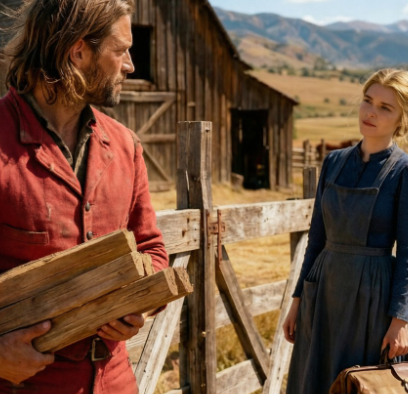
Callum, my Clara is too proud to ask for help and too good to need it, but circumstances have made liars of better people than her. I have told her to go to you. I know what I am asking. I know what you are. Look after her. That is all. E. Dutton.
Callum folded the paper carefully.
He looked out toward the canyon ridge, where a hawk turned slow circles in the cold air above the red rock. When he spoke, he did not look at her.
“Your father once carried me 8 miles through Paiute territory with an arrow in my left shoulder because I couldn’t ride. He did it in the dark, in the rain, and didn’t complain once. He sat with me for 2 nights after while fever fought to take me. Never asked for a thing.”….