
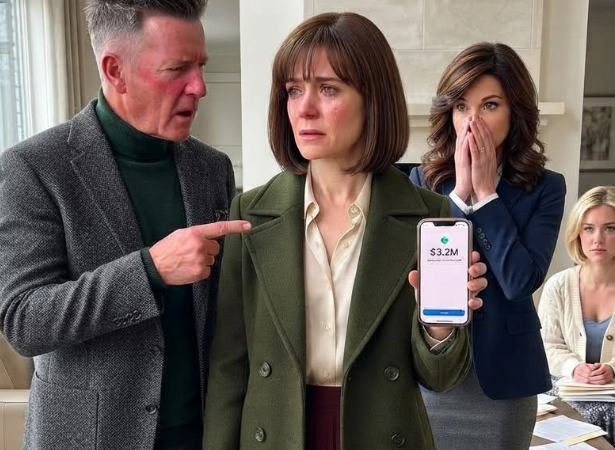
I accidentally overheard my father telling my sister, “Your sister? She’s not getting a penny.”
Then I looked at Mom.
She was smiling.
Not uncomfortably.

Not nervously.
She looked genuinely satisfied.
That expression told me everything I needed to know.
So I didn’t confront them.
I didn’t start an argument.
I simply grabbed my coat, went home, and moved $3.2 million before I went to sleep.
By the following morning, my phone was exploding with panicked calls from my entire family.
I was thirty-four years old when I finally learned there was a huge difference between being loved by your family and being valuable to them because of what you could provide.
It happened on a Sunday night at my parents’ house just outside Columbus, Ohio.
Dad, Richard Bennett, had invited everyone over for dinner because my younger sister, Chloe, was apparently “going through a transition.”
In our family, that phrase usually meant she had walked away from another job and needed someone to rescue her financially.
After dessert, I was carrying plates toward the kitchen when I heard voices coming from my father’s study.
The door was almost completely shut.
Then Dad said,
“Your sister? She isn’t getting a dime.”
I stopped walking.
Chloe’s voice dropped.
“But what about the family account?”
“That money stays with the people who deserve it,” Dad answered. “People who actually value this family.”
I turned toward the hallway.
Mom, Diane, was standing there.
She had heard every word.
But instead of looking uncomfortable or embarrassed, she smirked.
It wasn’t the kind of smile someone gives when they don’t know how to react.
It wasn’t nervousness.
It was the pleased expression of someone who already knew exactly what was being planned.
And agreed with it.
That one look changed everything.
For the previous eight years, I had built Bennett Clinical Logistics from a tiny medical courier operation with only two employees into a successful regional company serving hospitals across three states.
When I first launched the business, Dad had invested $200,000.
By the end of my third year, I had paid back every dollar.
With interest.
But my parents never stopped talking about the company as though it still somehow belonged to all of us.
The previous spring, I had sold a minority share of the business.
My portion of the sale came to $3.2 million.
I temporarily placed the money into a holding account that belonged entirely to my LLC.
The only reason I used the same private bank as my parents was because Dad had introduced me to one of its bankers years earlier.
Legally, the money was mine.
My parents had absolutely no ownership interest in it.
But they could see the balance.
Years before, Dad had persuaded me to connect the account to an old family banking dashboard.
He said it would allow him to “keep an eye on things” in case I ever needed help.
At the time, I hadn’t thought much of it.
Now Chloe’s recent questions suddenly made sense.
For weeks, she had casually asked when “the money” would be available.
I had assumed she was simply being nosy.
Now I understood exactly why she wanted to know.
Still, I said nothing.
I picked up my coat, told everyone I needed to get home because I had an early morning, and left.
At exactly 10:47 that night, I opened my laptop and logged into my company’s treasury system.
Thankfully, two months earlier, my attorney had warned me that the financial boundaries between my family and my business were becoming far too blurred.
He had strongly advised me to create a completely separate corporate banking structure.
I had listened.
A new account had already been opened at another institution.
So that night, I transferred the entire $3.2 million into it.
Then I removed my family’s viewing access to the old account.
After that, I closed my laptop and went to bed.
At 7:12 the next morning, my phone started vibrating across the nightstand.
Dad.
Mom.
Chloe.
Then Dad again.
By 7:19, I already had eleven missed calls.
A few seconds later, Dad left a voicemail.
“What the hell did you do?”
I played the message twice.
And for the first time in years, instead of feeling guilty or afraid, I smiled.
Because suddenly, they weren’t worried about me.
They were worried about the money they had quietly assumed would always be within their reach.
The full story continues in the comments