
He hadn’t stopped walking in fifteen years. Not for weather, not for traffic, not for people. The city existed to be cut through — a gray river of faces that parted the moment they saw the suit, the phone pressed to his jaw like a weapon, the jaw itself set hard as concrete. He was the kind of man buildings leaned away from.
“If this deal collapses,” he said into the phone, voice low and final, “fire everyone. Starting from the top.”
Then — a sound. Small. Plastic. Absurd. A tiny click against the leather of his shoe.
He looked down. A toy car. Red. Chipped at one corner. The kind you find in the bottom of a cereal box, or in the fist of a boy who has nothing else to hold onto. It had rolled through a forest of adult feet and stopped — impossibly, almost deliberately — against the one pair of shoes in the city that cost more than most people earned in a month.
He picked it up. Not out of kindness. Out of irritation.
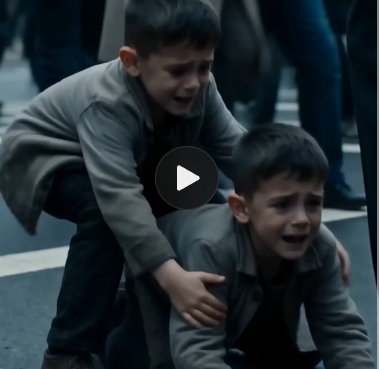
Two boys stood three feet away. Threadbare jackets. Faces tight with the particular fear of children who have learned that asking for things doesn’t always end well. The older one — maybe nine — held his younger brother’s hand. The younger one had fresh blood on his palm from where the pavement had caught him. He wasn’t crying. He was past crying. He was just looking at the car.
“How much,” the man said. Not a question. A transaction.
The older boy swallowed. “For our mother’s medicine, sir. She’s—” He stopped. Rehearsed this speech a hundred times, and still couldn’t finish it.
The younger one spoke instead, voice so small it barely existed: “Please don’t break it. Our dad gave it to us. Before he disappeared.”
The man turned the car over in his hand. Habit. The habit of a man who checks everything — contracts, clauses, the fine print of every deal. He looked at the underside.
There, scratched into the plastic with something sharp — a key, maybe, or a nail — four words:
“To my twins — Dad”
The phone fell out of his hand.
He didn’t notice. He didn’t notice the crowd either, or the rain beginning, or the fact that he was sinking — slowly, impossibly — to his knees on a wet city sidewalk in a twelve-thousand-dollar suit. He was looking at the boys. Then at the words. Then at the boys. His hands were shaking the way hands shake when the body understands something the mind is still refusing.
Twins. He had twins. He had had twins. Seven years ago, before the drinking, before the collapse, before he became whatever this thing in the suit was — he had sat on a kitchen floor with two small boys and scratched his name into the bottom of a red toy car with his house key, laughing, because they’d asked him to, because they said it would make it official, because—
His voice, when it came, was not the voice that fired people. It was not the voice that closed deals or ended careers. It was the voice of a man who had been dead for seven years and was only now being told.
“My sons…”
The older boy went still. The younger one took one step forward, then stopped — uncertain, trembling, a child standing at the edge of something enormous he doesn’t have a word for yet.
And then — across the street — a scream tore through everything.
A frail woman. Running into traffic. Their mother. His wife. The woman who had believed, for seven years, that the man she married was simply gone — not standing thirty feet away on wet pavement, holding a red toy car, crying in a suit.
A truck. Close. Accelerating.
The man looked up.
He had one second. One second to choose between the man he had been and the father he had abandoned. One second to decide if fifteen years of running was finally — mercifully — over.
Read the continuation in the comments.