
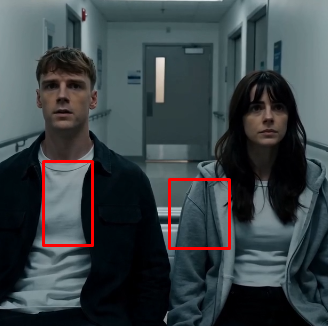
Nobody chooses who they sit next to at 3:00 AM in a hospital corridor.
You just collapse onto the nearest bench and stare at the floor and try to remember how to breathe. The fluorescent lights flicker overhead like they can’t quite commit to being on. The smell is antiseptic and old coffee and something underneath both that you don’t want to name.
She had been there for forty minutes before he arrived. She didn’t look up when he sat down at the far end of the bench. He didn’t look at her either. That’s the unspoken agreement of hospital waiting rooms at 3:00 AM — your grief is yours, mine is mine, we share only the bench.
Their hands rested beside each other without either of them noticing.
Same vein running along the inside of the wrist. Same pale crescent scar just below the thumb — the kind children get from a fall they can’t remember. Same shape of the knuckles. Same stillness.
A doctor came through the double doors. Stopped.
He looked at her. Then at him. Then back. Something moved across his face — not recognition exactly. More like arithmetic. The kind your brain does before your mouth is ready.
“Which one of you is the family?”
Both of them answered without thinking. The word came out at the same moment, in the same quiet, exhausted register.
“I am.”
Silence.
They turned to look at each other for the first time.
— — —
Later, she would not be able to explain what she felt in that first second. It wasn’t attraction. It wasn’t familiarity in any conscious sense. It was something more cellular — the way a tuning fork responds to its own frequency without being told to. Something in her chest simply said: oh. As if a question she’d been carrying her whole life had just heard its answer walk into the room.
He felt it too. She could tell. His eyes — dark, careful, the eyes of a man who controlled everything — went briefly unguarded.
“Who are you to her?” he said. His voice was quiet and very controlled. The voice of someone who had learned to keep a lid on things.
“Her daughter,” she said.
He didn’t move for a moment. Then: “That’s not possible.”
“Why?”
“Because she told me I was her only child.”
— — —
The photograph fell from her bag by accident. A corner of it had been sticking out — she’d been carrying it for weeks, meaning to frame it, never finding the right moment. It slipped, tumbled, and his hand caught it without thinking. A reflex. The reflex of someone who had always been quick.
He turned it over.
Two infants. Swaddled in the same white cloth. Lying side by side in what looked like a hospital crib not unlike the one somewhere behind those double doors right now. Same dark hair. Same furrowed, brand-new faces. Same everything.
On the back, in handwriting he recognized immediately — his mother’s — a date. Thirty-one years ago. And two names.
One of them was his.
He had not breathed since he caught the photograph. He became aware of this and forced himself to inhale.
Her voice, when it came, was barely holding itself together. “She had twins.”
“No.” The word came out automatically. A wall going up. “No. They told me — they told me my sister died at birth.”
“They told me my brother did.”
He looked up from the photograph. She was pulling back her sleeve. Slowly. The way you reveal something you have shown no one, or perhaps everyone, but never like this.
A birthmark. Small. Crescent-shaped. Inside of the left wrist, just below the thumb.
He went completely still.
The corridor was silent except for the flicker of the light above them. Somewhere far away, a monitor beeped in steady rhythm — their mother’s heartbeat, still going, still insisting.
He pulled back his own sleeve.
— — —
The same mark. Same wrist. Same shape. Same place.
Neither of them spoke.
There are moments in a life so large they have no sound. You don’t cry. You don’t move. You simply exist inside the moment while it rewrites everything — every memory, every photograph, every time you felt a room was missing someone and couldn’t say who.
She had felt it her whole life. The missing. The specific shape of an absence she had no name for. She’d thought it was her father, who left early. She’d thought it was loneliness, the ordinary kind. She’d thought it was just the way she was built — always looking for someone on the other side of a room.
It was him.
It had always been him.
He reached across the bench. Not all the way. Just enough. An offering. His hand, palm up, birthmark visible, between them on the cold plastic of the seat.
She looked at it for a long time.
Then she placed her hand in his.
The doctor, still standing in the doorway, said nothing. He had been doing this for twenty-two years. He had delivered news that broke people and news that rebuilt them and every variation in between. But he had never seen anything like this.
He stepped quietly back through the double doors.
He would give them a minute.
Some things medicine has no protocol for.
Read the continuation in the comments.